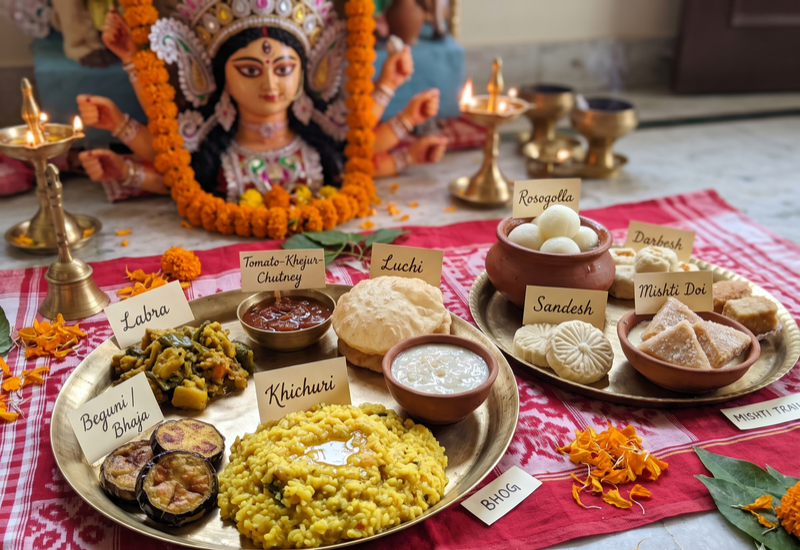
Bengal’s Durga Puja is a celebration of devotion, tradition and cultural heritage. The festival marks the Goddess’s return to her parental home and her victory over Mahishasura. In Bengal, this homecoming is celebrated not only through elaborate pandals, rituals and community gatherings but also through the food prepared and shared during the festivities.
In 2026, the main days of Durga Puja ran from Shashthi on 16 October to Bijoya Dashami on 20 October. At the heart of the festival’s culinary traditions is bhog, a meal first offered to Goddess Durga and then distributed among devotees and visitors at the pandals.
The Tradition of Durga Puja Bhog
Bhog holds a special place in Bengali Durga Puja celebrations. It represents devotion, gratitude and the spirit of sharing, bringing people together through food offered to the Goddess.
The traditional bhog plate is simple yet carefully balanced, with preparations that reflect the region’s culinary preferences and seasonal ingredients.
One of the most familiar dishes is bhoger khichuri. Its preparation begins with moong dal, which is dry-roasted until golden and fragrant. The roasted lentils are then cooked with gobindobhog rice, ginger, bay leaf and vegetables until the mixture becomes soft and creamy. A finishing touch of ghee adds richness and aroma.
Alongside khichuri is labra, a mixed vegetable preparation made with ingredients such as pumpkin, potato, brinjal and radish. Its combination of vegetables creates a dish that is both nourishing and flavourful.
The bhog spread often includes crisp beguni, made by coating slices of brinjal in seasoned batter and frying them until golden. A sweet-and-sour tomato and date chutney adds another layer of flavour, while a bowl of payesh completes the meal.
Traditionally served on sal leaves, the Durga Puja bhog plate demonstrates how simple ingredients, careful preparation and familiar cooking techniques become part of a meaningful festive experience.
The Mishti Trail: Celebrating Bengal’s Sweet Heritage
No discussion of Bengali festive food is complete without mishti. Sweets are an important part of the region’s culinary identity, and Durga Puja provides an opportunity to enjoy some of its most celebrated preparations.
A traditional Bengali sweets selection includes rosogolla, sandesh, langcha, pantua and chhanar jilipi. Regional specialities such as mihidana and sitabhog from Bardhaman further illustrate the diversity of Bengal’s sweet-making traditions.
Many of these preparations are based on chhena, or fresh cottage cheese. Bengali confectioners developed remarkable techniques for transforming this ingredient into a wide variety of sweets, particularly from the nineteenth century onwards.
The variety of textures, shapes and flavours reflects generations of confectionery knowledge. From soft and syrup-soaked sweets to delicate milk-based preparations, each has its own place in Bengal’s festive food culture.
Mishti Doi: The Art of Traditional Fermentation
Among Bengal’s most recognisable desserts is mishti doi, a sweetened fermented yoghurt traditionally prepared in clay pots.
A traditional mishti doi recipe begins with full-fat milk, which is slowly reduced by approximately one-third to create a thicker consistency. It is then sweetened with caramelised sugar or, during the winter season, with nolen gur, a date palm jaggery valued for its distinctive flavour.
A small quantity of curd is added to initiate fermentation, and the mixture is left to set in clay pots. These pots gradually absorb moisture, helping develop the dense and creamy texture associated with traditional mishti doi.
The process requires time and attention. Much of its success depends on judging the temperature of the milk before adding the curd, a skill traditionally learned through experience rather than precise measurements.
Mishti doi is therefore more than a dessert. It represents the knowledge of traditional fermentation and the careful techniques that have shaped Bengal’s culinary heritage.
Community Kitchens and the Spirit of Sharing
Durga Puja food is closely connected with community participation. The preparation and distribution of bhog bring together volunteers, cooks, families and devotees, making the kitchen an important part of the festival.
Community kitchens prepare large quantities of food while following traditional methods. The experience of preparing bhoger khichuri, labra and other dishes is often shared across generations, with experienced cooks guiding younger members through each stage.
Family kitchens also play an important role in preserving these traditions. Recipes for festive sweets, chutneys and special preparations are frequently passed down through observation, practice and family memories.
These food traditions show how culinary knowledge can survive through everyday participation, even when recipes are not formally documented.
Preserving Bengal’s Durga Puja Food Heritage
Bengal’s Durga Puja cuisine represents a rich combination of ritual, regional ingredients and culinary craftsmanship. From the simplicity of bhoger khichuri to the artistry of chhena-based sweets, each preparation carries a story of cultural continuity.
Many of these recipes have been preserved through community kitchens and family elders rather than written cookbooks. Their techniques, proportions and small details are often learned by watching someone prepare the dish.
As food habits evolve, documenting these traditional preparations becomes increasingly important. Recording recipes, understanding their regional variations and preserving the techniques behind them can help younger generations remain connected to their culinary roots.
Watching the Goddess depart on Bijoya Dashami is an important part of Durga Puja. But remembering how her bhog was prepared, how sweets were made and how food brought communities together is equally valuable.
Ultimately, preserving Bengal’s festive food traditions means preserving more than recipes. It means carrying forward the knowledge, memories and shared experiences that make Durga Puja such an important part of India’s culinary heritage.