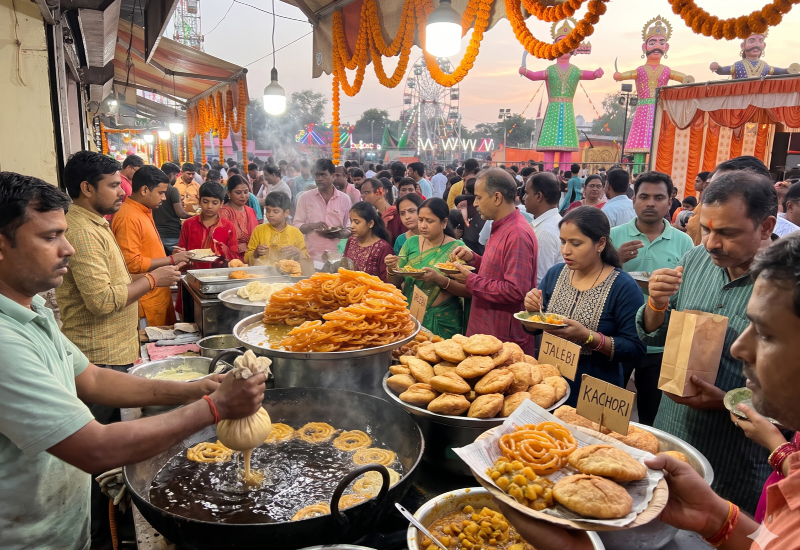
Dussehra, also known as Vijayadashami, is one of India’s most significant festivals, marking the victory of good over evil. It commemorates Lord Ram’s victory over Ravana and, in eastern India, the Goddess’s triumph over Mahishasura. In 2026, the festival fell on 20 October, bringing the nine nights of Navratri celebrations to a close.
Across North India, Dussehra is traditionally marked by the burning of Ravana’s effigies at Ramlila grounds, accompanied by community gatherings, performances and festive food. For many families, the evening has a familiar culinary combination of its own: hot, flaky kachori followed by crisp, syrup-soaked jalebi.
The Food Traditions of Ramlila
Dussehra’s culinary traditions are closely connected with the celebrations surrounding Ramlila. Weeks of performances bring temporary food stalls to festival grounds, offering familiar street foods such as chaat, golgappe and aloo tikki.
The final evening often becomes the busiest, with halwais preparing fresh snacks and sweets in large iron kadhais. The aroma of freshly fried food becomes part of the festive atmosphere, bringing together families, visitors and communities.
The combination of jalebi and kachori is particularly cherished across North India, from Delhi and Lucknow to Jaipur and Varanasi. While the pairing may seem simple, both preparations reflect generations of traditional cooking knowledge.
Jalebi: A Sweet with a Long Culinary History
Jalebi is one of India’s most recognisable traditional sweets, known for its distinctive spiral shape, crisp texture and sugary coating.
Its history extends beyond modern festive celebrations. Food folklore links a similar preparation called shashkuli with Lord Ram. Food historian P. K. Gode traced references to jalebi in Indian texts to at least the fifteenth century. Its culinary relatives, including zulbia in Iran and zalabiya in the Arab world, also reflect the wider history of this spiral-shaped sweet.
A traditional jalebi recipe begins with preparing a batter using maida, a little besan and curd. The mixture is left to ferment overnight, allowing it to develop the characteristic texture and flavour.
The fermented batter is then piped into hot ghee in circular spirals and fried until crisp. Once cooked, the jalebis are briefly immersed in a one-string sugar syrup flavoured with saffron and cardamom.
The contrast between the crisp exterior and sweet syrup makes jalebi a familiar favourite during festivals and special occasions.
Kachori: A North Indian Street Food Favourite
Kachori has a long association with the culinary traditions of Rajasthan and is often linked with Marwari traders, who valued food preparations that could be stored and carried during long journeys.
Over time, different regions developed their own versions, each reflecting local ingredients and cooking preferences.
Some popular varieties include khasta kachori from Uttar Pradesh, pyaaz kachori from Jodhpur and moong dal kachori associated with Old Delhi.
A traditional moong dal kachori recipe begins with a dough enriched with ghee. The filling is prepared using coarsely ground moong dal, roasted with hing, saunf and amchur to create a distinctive combination of flavours.
The filled kachoris are then fried slowly over low heat. This gradual cooking allows the outer layer to become flaky and crisp rather than hard, while ensuring that the filling cooks properly.
The variety of regional kachoris demonstrates how a familiar preparation can develop distinct identities across different parts of India.
The Art of Traditional Halwai Cooking
Jalebi and kachori may be widely available today, but preparing them well requires considerable experience.
A halwai must understand how long a batter needs to ferment, how to control the temperature of the ghee, how to achieve the right consistency of sugar syrup and how slowly a kachori should be fried.
Much of this knowledge is traditionally acquired by working alongside experienced cooks and family members. These techniques are often taught through observation and practice rather than written measurements.
The preparation of festive food therefore represents more than a cooking process. It reflects years of experience, inherited skills and regional culinary knowledge.
Preserving Dussehra’s Culinary Traditions
Dussehra is remembered for its cultural significance, Ramlila performances and the symbolic burning of Ravana’s effigy. Yet, the food associated with these celebrations is also an important part of the festival’s identity.
The pairing of jalebi and kachori brings together different culinary histories, regional influences and traditional cooking techniques. From the fermentation of jalebi batter to the slow frying of kachori, each preparation carries knowledge that has been developed and refined over generations.
As food traditions evolve, preserving these techniques becomes increasingly important. Documenting traditional recipes, understanding their regional variations and encouraging younger generations to learn from experienced halwais can help keep this culinary heritage alive.
The effigy of Ravana burns in a few minutes, but the craft behind the evening’s food takes years to master.
By preserving these recipes and the stories behind them, we preserve another meaningful part of India’s festive and culinary heritage.