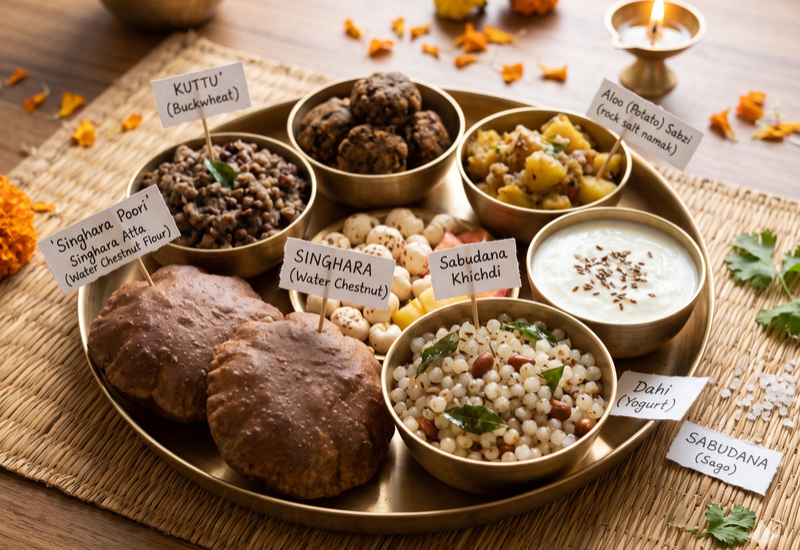
The Navratri vrat thali is an important part of India’s festive food traditions. Sharad Navratri is observed over nine nights in devotion to Shakti, and for many families, it is also a period when everyday cooking follows a different set of dietary practices. In 2026, the festival began on 11 October and concluded with Vijayadashami on 20 October.
During these nine days, many households in northern and western India replace wheat and ordinary rice with ingredients traditionally used for fasting. Three ingredients often take centre stage in the vrat thali: kuttu, singhara and sabudana. Each has its own history, culinary characteristics and place in India’s regional food traditions.
Kuttu: The Himalayan Connection
Kuttu, commonly known as buckwheat, is not technically a cereal grain. It is the seed of a flowering plant related to rhubarb. This distinction is one reason it is traditionally included in many fasting diets when regular grains are avoided.
Kuttu has a long history of cultivation in the Himalayan region. Communities in Ladakh, Himachal Pradesh and Uttarakhand have traditionally used it to prepare breads, pancakes and other everyday dishes.
One of the best-known preparations is kuttu ki puri. Since buckwheat flour does not contain gluten, it cannot hold together in the same way as ordinary wheat flour. Mashed boiled potatoes are therefore often added to bind the dough, along with sendha namak. The puris are rolled relatively thick and fried until cooked.
This preparation demonstrates how traditional cooking techniques adapt to the natural properties of different ingredients.
Singhara: The Water Chestnut Flour
Singhara, or water chestnut, comes from an aquatic plant that grows in ponds beneath floating leaves. Its dried kernels are ground into flour, commonly known as singhare ka atta, which is used in several fasting preparations.
One familiar dish made with this flour is singhare ka halwa. Its preparation requires patience, particularly during the roasting stage. The flour is slowly roasted in ghee until it becomes fragrant, after which hot water and sugar are added to create a smooth, glossy preparation.
Singhara flour is also used in puris, pancakes and other traditional fasting foods.
Its use reflects the diversity of ingredients found in Indian regional kitchens, where locally available produce has shaped food practices over generations.
Sabudana: From Tapioca to the Vrat Thali
Sabudana has a particularly interesting history. The familiar white pearls are made from tapioca starch, obtained from cassava, a root crop that originated in South America. Cassava was introduced to India through Portuguese trade, and sabudana manufacturing developed around Salem in Tamil Nadu during the 1940s.
Today, sabudana is closely associated with fasting food across several Indian states.
A popular preparation is sabudana khichdi, which depends on getting the soaking process right. The pearls need to be soaked long enough to soften but not so long that they become sticky.
They are then tossed in ghee with cumin, potatoes and roasted peanut powder to create a flavourful dish.
Another familiar preparation is sabudana vada, in which soaked pearls are combined with potatoes, peanuts and seasonings before being shaped and fried.
These dishes demonstrate how a single ingredient can become part of different culinary traditions across India.
Regional Flavours That Define Navratri Vrat Food
Navratri fasting food is not the same everywhere. Ingredients, cooking methods and traditional preparations vary considerably across regions and communities.
In Gujarat, farali pattice and moraiyo are familiar fasting preparations. Maharashtra has its own distinctive food traditions, including sabudana vada and upvasacha thalipeeth.
In Tamil Nadu, sundal is traditionally prepared and offered to visitors who come to see the Golu displays during Navratri. Made using legumes and seasoned with ingredients such as mustard seeds, curry leaves and coconut, it reflects the region’s distinctive festive food culture.
Together, these preparations show that Navratri cuisine extends well beyond a fixed list of fasting ingredients. It is shaped by regional produce, household customs and generations of culinary knowledge.
Preserving the Knowledge Behind Vrat Recipes
The techniques involved in preparing traditional Navratri food are often learned through observation and practice rather than written instructions.
Knowing how long sabudana should be soaked, why potatoes are used to bind kuttu flour or how slowly singhara flour needs to be roasted requires practical experience.
These details are rarely mentioned on a packet of flour or in a simple ingredient list. They are passed down when one generation cooks alongside another, sharing methods, preferences and small adjustments that make a dish successful.
As food habits change and younger generations become less familiar with traditional cooking methods, documenting these recipes and techniques becomes increasingly important.
Preserving Navratri food traditions therefore means more than recording the names of dishes. It means understanding the ingredients, remembering their regional histories and passing on the skills required to prepare them.
Ultimately, the Navratri vrat thali is a reflection of India’s diverse culinary heritage. Behind kuttu, singhara and sabudana lies a history of agriculture, migration, regional adaptation and family knowledge.
By keeping these traditions alive, we preserve not just the food prepared during nine nights of devotion, but also the cultural stories and culinary skills that connect generations.