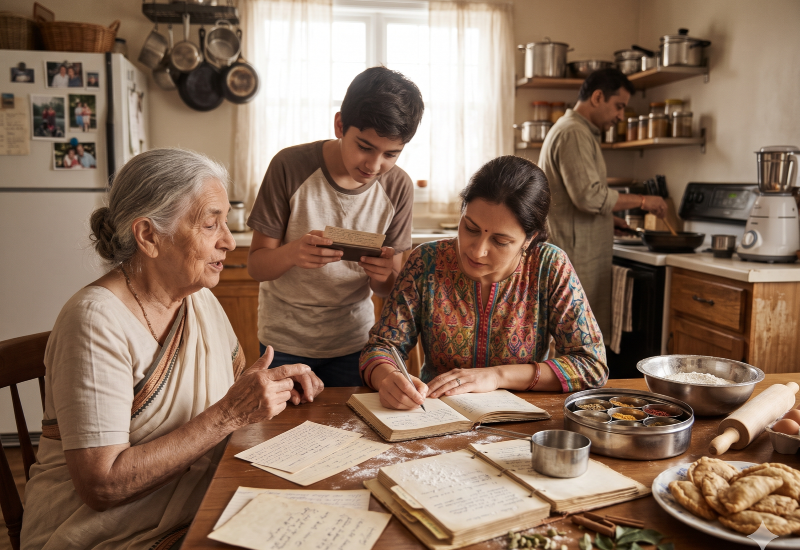
**Why Should We Document Our Family Recipes?**
Think about the one dish that instantly reminds you of home.
It could be your grandmother’s dal, your mother’s special festive sweet or a simple dish that was always prepared on Sundays. You may have eaten it hundreds of times, but somehow, it never tastes quite the same when someone else makes it.
Have you ever wondered why?
Perhaps it’s the way your grandmother roasted the spices, the little extra ghee your mother added, or an ingredient that was never measured but always added by instinct.
These small details are what make family recipes special.
But here’s something we often overlook: **What happens when the person who knows the recipe by heart is no longer around to make it?**
Family Recipes Are More Than Ingredients
We often think of recipes as a list of ingredients and instructions. But family recipes carry much more than that.
They tell us about the people who cooked them, the occasions on which they were prepared and the traditions that shaped our food habits.
A particular sweet may remind us of Diwali celebrations at our grandparents’ home. A special curry may bring back memories of family gatherings. Even a simple bowl of dal can carry the warmth of a familiar kitchen.
Every family has its own way of cooking.
The same dish may taste different in two neighbouring homes because of a particular spice blend, a cooking technique or a small addition that has been passed down over generations.
These differences are part of our culinary identity.
The Knowledge That Lives in Our Kitchens
Think about how many recipes in Indian households are still passed down orally.
Our elders rarely need measuring cups. They know how much flour to take by looking at it, how long to roast the spices by their aroma and when a dish is ready just by its texture.
Their instructions often sound familiar:
– Add a little more water.
– Roast it until the aroma changes.
– Let it cook until the oil separates.
– Add the masala until it feels right.
This is practical culinary knowledge developed through years of experience.
But much of it remains undocumented. The ingredients may be remembered, but the little techniques, timings and stories behind a dish can easily get lost.
When we don’t record these details, we risk losing more than a recipe. We risk losing the knowledge that makes it special.
Why Documenting Family Recipes Matters
1. It keeps family traditions alive.
Writing down recipes helps younger generations understand how certain dishes were prepared and why they were important to their families.
2. It preserves regional food knowledge.
India’s culinary heritage is incredibly diverse. Family recipes often preserve local ingredients, cooking methods and food practices that may not appear in mainstream cookbooks.
3. It saves the stories behind the food.
Who first made the dish? Was it prepared during a festival? Was there a special occasion when everyone gathered around the table?
These stories give a recipe its meaning.
4. It helps traditions travel across generations.
As families move to different cities and countries, familiar ingredients and cooking practices may become harder to access. A documented recipe helps people stay connected to the food they grew up with.
How Can You Preserve Your Family Recipes?
You don’t need to write a cookbook to begin. Start with the recipes that matter most to your family.
– **Ask your elders:** Sit with your grandparents or parents and ask them to share their favourite recipes.
– **Write down the details:** Record ingredients, quantities, cooking time and techniques, including the little things that are usually explained verbally.
– **Record the process:** Take photographs or videos while the dish is being prepared.
– **Save the stories:** Note when the dish is traditionally made, who taught the recipe and what memories are associated with it.
– **Create a family recipe collection:** Keep everything in a notebook, digital document or shared family folder.
Even a simple handwritten recipe can become something valuable for the generations that follow.
Your Family’s Food Story Deserves to Be Remembered
We often think of inheritance in terms of jewellery, property, photographs and family possessions.
But there is another kind of inheritance that lives in our kitchens.
It is the taste of a familiar meal, the aroma of spices roasting in a pan, the techniques our elders never had to write down and the recipes that bring families together.
These recipes are living memories. They connect us to our roots and tell us something about where we come from.
**So, before the next family gathering, ask your mother, father or grandparents to teach you that one recipe you have always loved. Write it down. Record it. Pass it on.**
Because the best way to preserve a food tradition is to make sure it is never forgotten.